What to do today
- Say the Shahada slowly.
- Thank Allah in your own words.
- Save one trusted resource.
- Do not overwhelm yourself.
New Muslim Journey
A gentle roadmap for your first month as a Muslim. This is not a checklist for perfection. It is a calm way to begin, one step at a time.
After this guide you'll know
Save or print this guide
Day 1
Shahada is the entry into Islam: worship Allah alone and accept Muhammad (peace be upon him) as His Messenger. You do not need to know everything immediately. Today can be a day of gratitude, rest, and one short private dua.
O Allah, guide me, strengthen me, and make this path easy for me.
Week 1
This week, your goal is not perfection. Your goal is familiarity. Learn the names of the prayers, choose one prayer to practice with guidance, and keep asking Allah for help. Reading from notes while learning is normal.
Salah Starter Guide
Salah is the daily prayer. If you are new, start gently. At first, focus on learning where to pray, when to pray, how to prepare with wudu, and the basic movements. You can improve gradually, and your local Imam or teacher can guide you on details.
This is a beginner companion, not a fatwa source. Your local Imam or teacher can guide you on details.
Salah can be performed in any clean place, including a quiet part of your home. The masjid is preferred and beautiful when possible, but if getting there is difficult, unsafe, or you have not disclosed your Islam yet, begin at home calmly.
Each prayer has a time window. Check your local masjid prayer timetable when you can, and know that many reliable prayer-time apps are also available. Use your local location settings carefully.
Muslims pray facing the Qiblah, the direction of the Ka'bah in Makkah. A local masjid, a trusted app, or a qiblah compass can help you find the direction.
A prayer rug is helpful, but it is not required. Any clean surface is enough. If privacy matters, you can use a clean towel, mat, or quiet clean area.
Wudu Guide
Wudu is a simple washing before prayer. It helps you prepare your body and heart for salah. Many people learn wudu by practicing slowly a few times, so do not despair if you are still learning.
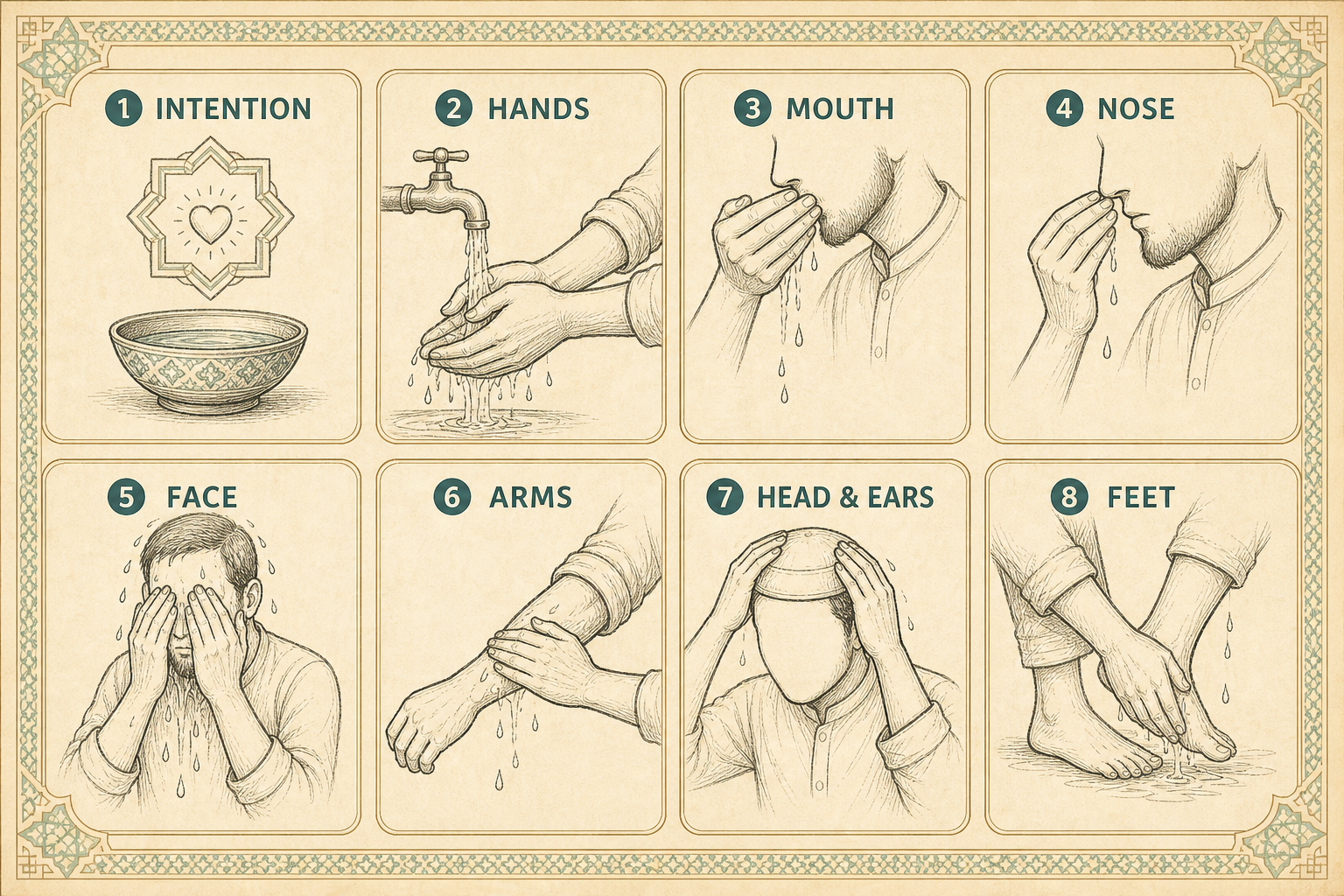
Visual summary of the basic wudu steps for beginners.
In your heart, intend to make wudu for prayer. No need to say a long formula out loud.
Quietly say: Bismillah.
Wash both hands up to the wrists. Start with the right hand, and make sure water reaches between the fingers.
Rinse your mouth gently.
Gently take water into the nose and clear it. For beginners, keep it gentle.
Wash the full face from hairline to chin and ear to ear.
Wash right arm from fingertips to elbow, then the left arm from fingertips to elbow. Include the elbows.
Wipe over the head with wet hands.
Wipe inside and outside the ears gently.
Wash right foot including ankles, then the left foot including ankles. Make sure water reaches between toes.
Salah Steps
After wudu, stand for salah. This is a beginner guide, and there are valid differences in some details of prayer. Follow a trusted local Imam or teacher for detailed practice.
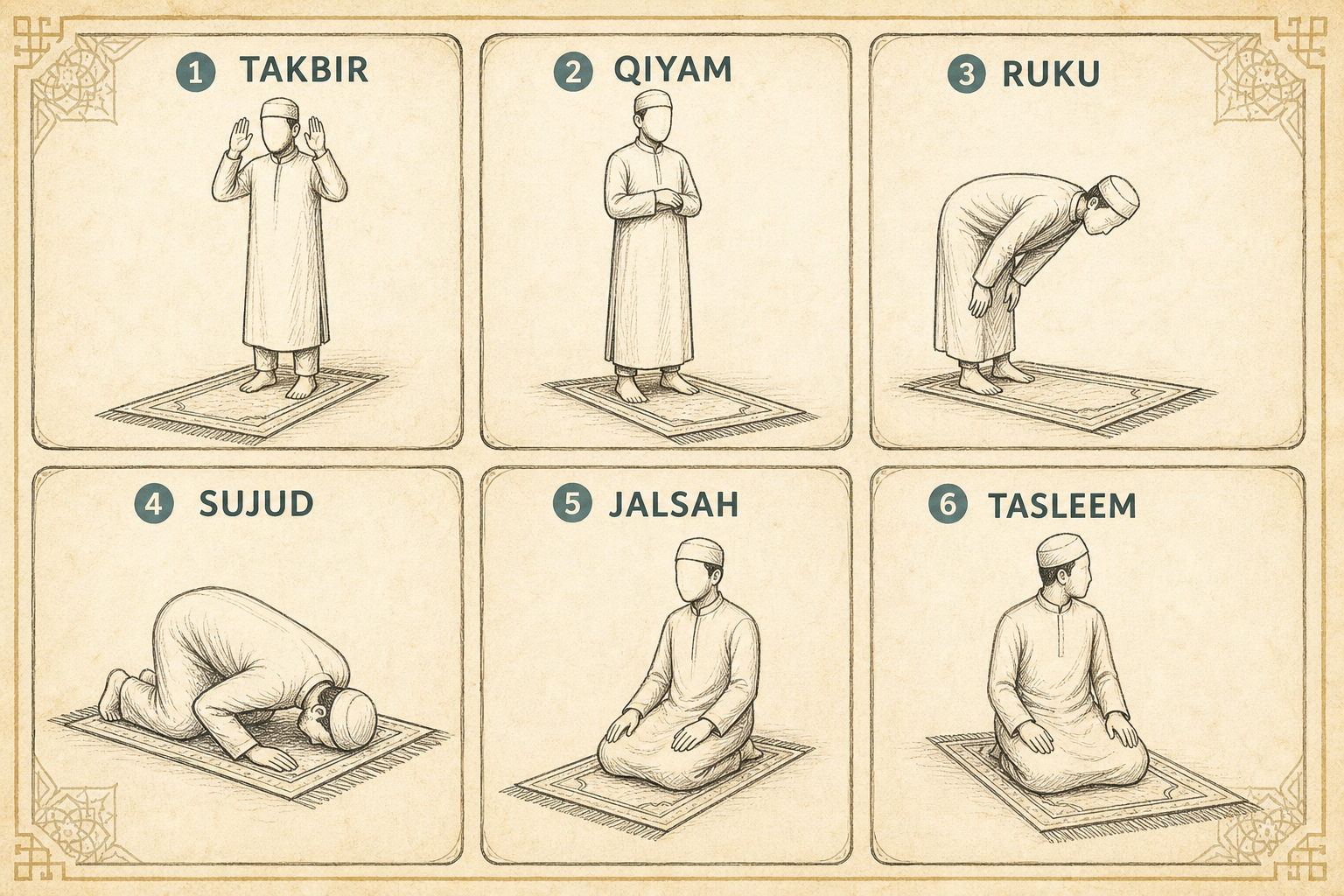
Visual summary of the main salah postures.
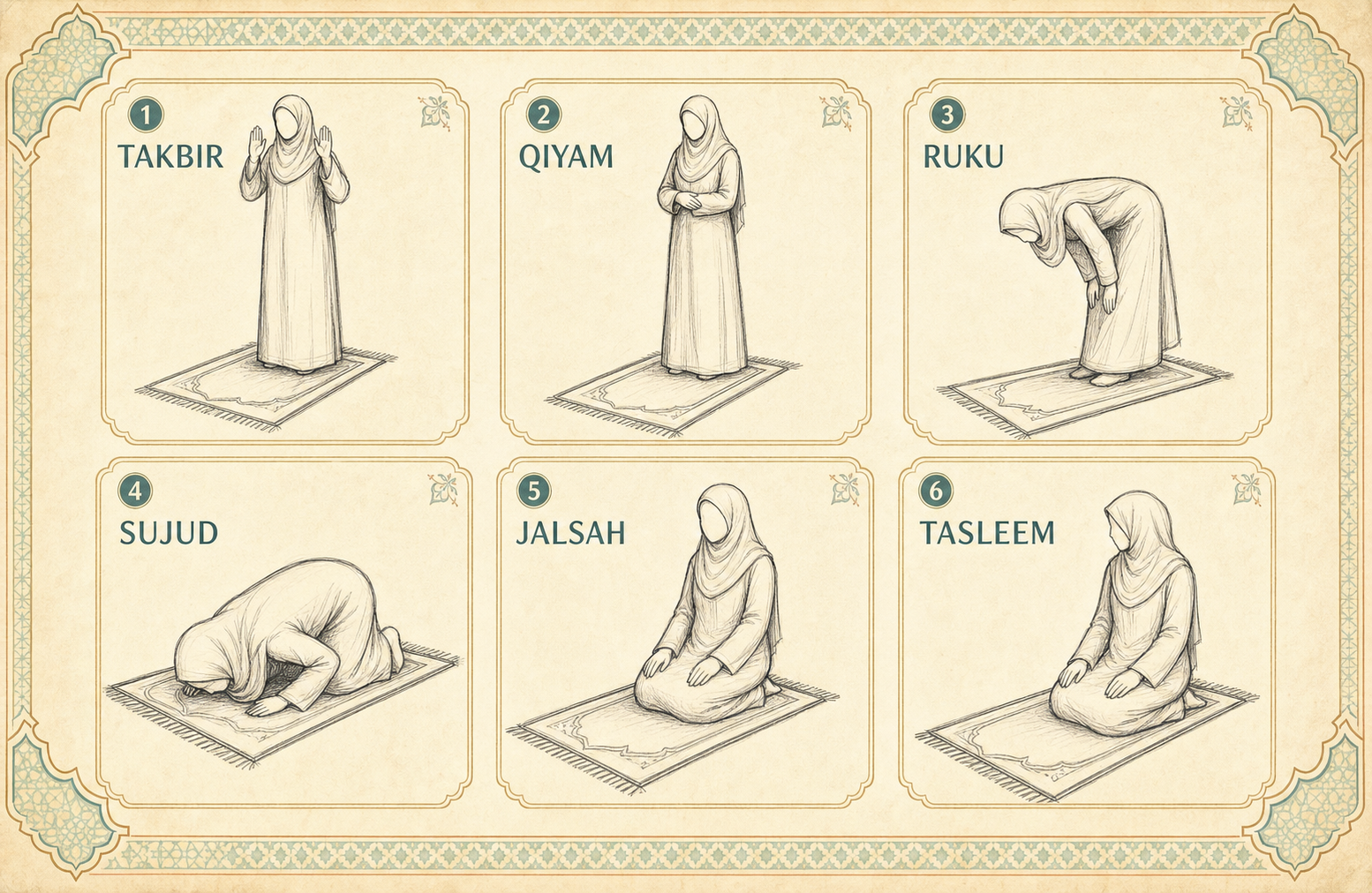
Visual guide for sisters learning the main salah postures.
Face the Qiblah, make intention in your heart, raise your hands, and say Allahu Akbar.
Recite Al-Fatihah if you know it. If you are still learning, use transliteration and practice gradually.
Bow with hands on knees and say: Subhana Rabbiyal Adheem.
Return upright and say: Sami Allahu liman hamidah, Rabbana wa lakal hamd.
Prostrate with forehead, nose, hands, knees, and toes touching. Say: Subhana Rabbiyal A'la.
Sit briefly between prostrations and ask Allah for forgiveness.
Repeat sujud calmly.
Prayers have 2, 3, or 4 rakahs depending on the prayer. Use a trusted guide, app, Imam, or teacher for the full structure.
Pronunciation Practice
Audio will be added only after suitable local recordings are reviewed. For now, practice slowly with the transliteration.
Allah is the Greatest
Opening and movement phrase
Audio coming soon. Practice slowly with the transliteration for now.
Glory be to my Lord, the Most Great
Said in ruku
Audio coming soon. Practice slowly with the transliteration for now.
Allah hears the one who praises Him
Said when rising from ruku
Audio coming soon. Practice slowly with the transliteration for now.
Our Lord, to You belongs all praise
Said after standing from ruku
Audio coming soon. Practice slowly with the transliteration for now.
Glory be to my Lord, the Most High
Said in sujud
Audio coming soon. Practice slowly with the transliteration for now.
My Lord, forgive me
A short dua between prostrations
Audio coming soon. Practice slowly with the transliteration for now.
Mistakes while learning do not mean you are failing. Keep trying, keep learning, and ask Allah for help.
Week 2
Begin learning what Islam is built on: worship, mercy, good character, Quran, and the example of the Prophet Muhammad (peace be upon him). Basic halal and haram matter, but do not turn your first weeks into a flood of rules. Choose one reliable resource and grow steadily.
Week 3
MuslimSafeSpace is built for people who may need privacy. Not everyone needs to know immediately. If family, housing, work, or safety could be affected, move carefully and ask for private guidance. Build habits slowly and look for one trusted Muslim contact.
Week 4
Community can help, but it should not feel like pressure. Visit a masjid when you are ready, ask about beginner classes, and request sisters-only or brothers-only support if that helps you feel safer.
Practical Support
It is normal to feel nervous before your first visit. You can go slowly, ask simple questions, and leave if you feel overwhelmed. Your local Imam or teacher can guide you on details.
Choose clean, modest clothing that feels respectful and comfortable. If you are unsure, simple loose clothing is a good start.
Many masjids have separate entrances or prayer areas. If signs are unclear, ask calmly at the door or call ahead.
Prayer areas are usually shoe-free. Look for shelves or where others leave their shoes.
Yes. You can visit quietly, observe, and ask questions afterward. You do not need to know Arabic to enter.
Ask for the Imam, a new Muslim coordinator, or a trusted volunteer. You can simply say, 'I am new and would like beginner guidance.'
If you prefer sisters-only support, it is okay to ask for a woman contact, a sisters class, or a private follow-up.
If you feel unsure, ask for a brother who helps new Muslims or someone who can sit with you during a short first visit.
You can leave, pause, or try again another day. A short sincere visit is still meaningful.
Gentle Reassurance
Arabic takes time. Begin with meanings, transliteration, and small phrases. Your next step can be learning Al-Fatihah one line at a time.
Do not worry about perfection at the beginning. Practice the movements and core phrases, then ask a teacher to help you refine details.
Many people grow slowly after Shahada. Pick one habit to improve and keep returning to Allah with honesty.
You do not have to handle every conversation immediately. Protect your safety and seek private guidance before difficult discussions.
Look for beginner-friendly support, English-friendly classes, or a named new Muslim contact. If you are unsure, ask privately first.
Big changes can bring big feelings. Rest, make dua, and speak to a safe person. If you are in danger or crisis, contact local emergency or professional help.
Qualified Guidance
This page is a beginner companion, not a fatwa source. For details, your local Imam or teacher can guide you. For immediate danger, abuse, self-harm, or medical emergencies, contact local emergency services or qualified professional support.
Keep a private copy for later, or print a simpler version to review offline.
If someone you know recently became Muslim or is exploring Islam privately, you can share this guide with them.
Continue learning
Prayer times, movements, meanings, and practice without overload.
A visual, beginner-friendly preparation guide before prayer.
Practical reassurance for a first visit and finding safe local support.
Small daily remembrances for steadiness, gratitude, and closeness to Allah.
Keep exploring questions that often come next.
Readers also explore